Solar Panels and Heat Pumps Together: Do They Make a Good Pair?
Why solar PV and an air source heat pump complement each other, how much of a heat pump’s electricity solar can realistically cover, and how to sequence the two installations.

In short: they pair well, with one honest caveat. A heat pump raises your electricity use, and solar panels reduce the amount of electricity you buy — but solar generates most in summer while a heat pump consumes most in winter. Solar typically covers a meaningful slice of annual heat pump consumption, not all of it, and covers hot water especially well from spring to autumn.
Why the combination makes sense
A heat pump moves your heating from gas or oil onto electricity. That makes the price you pay per kilowatt-hour of electricity the single biggest driver of your heating bill. Every kilowatt-hour your roof generates and you use yourself is a kilowatt-hour you do not buy — so the more of your own generation you consume, the cheaper the heat pump is to run.
There are practical synergies too:
- Shared works. Scaffolding, electrical upgrades and consumer unit work can be done once instead of twice.
- One design conversation. The electrical design (supply capacity, circuits, export limits) is planned as a whole.
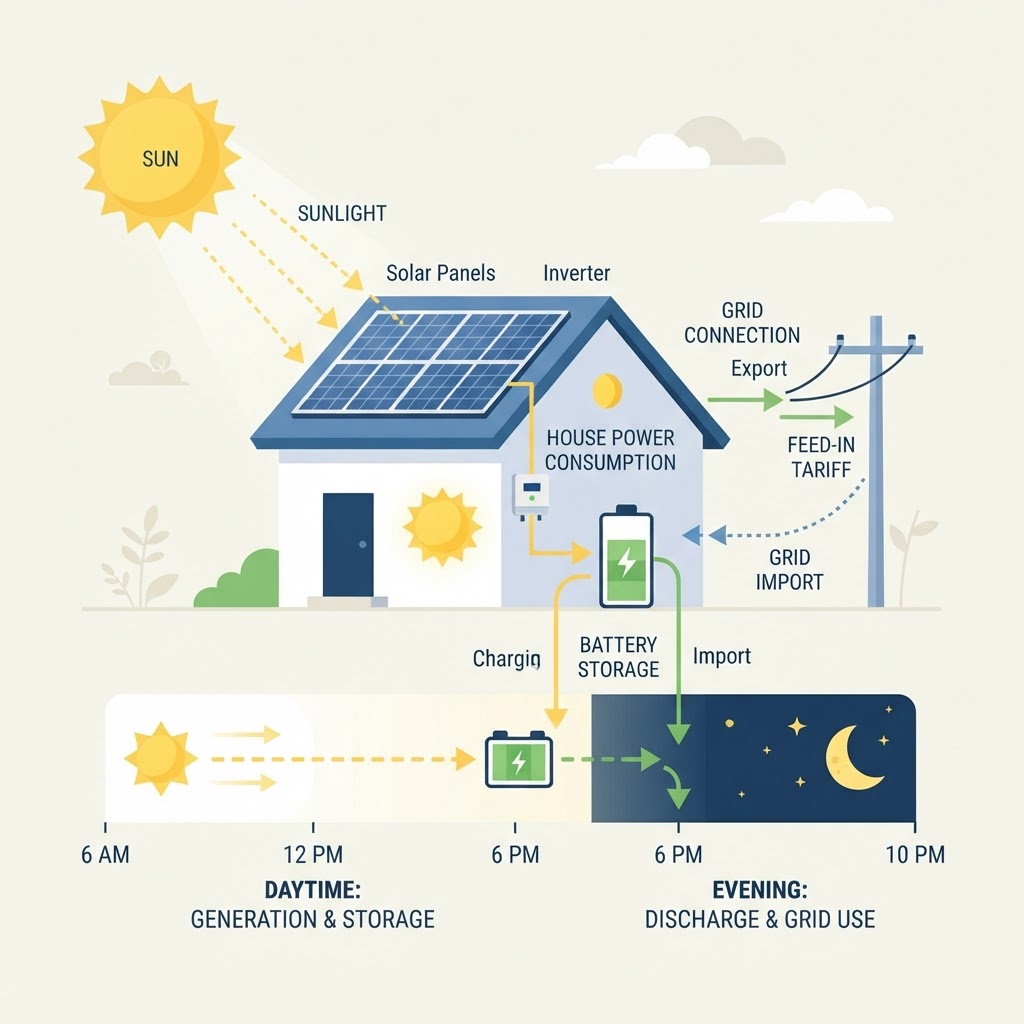
- Hot water in daylight. A heat pump cylinder can be timed to heat water in the middle of the day, running largely on your own solar generation for much of the year.
The seasonal mismatch, honestly stated
Solar generation in the UK peaks in May–July; heat pump demand peaks in December–February, when a panel produces perhaps a fifth of its summer output and the heating runs longest. So:
- Hot water: largely solar-powered from roughly April to October in a well-set-up system.
- Shoulder seasons: solar makes a real contribution to space heating, which runs mainly in mornings and evenings.
- Deep winter: the heat pump runs mostly on imported electricity, ideally on a heat-pump-friendly or off-peak tariff.
Across a whole year, a typical 4–5kWp array might offset somewhere in the region of 20–40% of a heat pump’s consumption directly, depending on system sizes, occupancy and controls. Treat any precise promise with suspicion — it depends heavily on how and when you use energy.
Does a battery change the picture?
A battery raises self-consumption by storing midday surplus for the evening. In summer it can push solar self-sufficiency very high. In winter its solar role shrinks (there is little surplus to store), but it earns its keep a second way: charging cheaply overnight on an off-peak tariff and running the house — including the heat pump — on that cheaper electricity during the day. For heat pump households, tariff optimisation is often the stronger argument for a battery than solar storage alone.
Sizing the pair
- Size the heat pump to the heat loss. Never to the solar array. The heat pump must carry the house on a sunless January night.
- Size the solar to the roof and your consumption. With a heat pump (and perhaps an EV) in the picture, annual electricity use rises substantially, which strengthens the case for filling the roof while the scaffolding is up.
- Cylinder controls matter. A cylinder heated at 12:00–14:00 instead of 06:00 shifts a chunk of demand into solar hours at zero hardware cost.
Which should come first?
If you cannot do both at once:
- Insulation first, always — it shrinks the heat pump you need.
- Heat pump before solar if your boiler is failing or a grant window applies — the grant applies to the heat pump, and its electrical works can pre-provision for solar.
- Solar before heat pump if your roof is due for work anyway, or you want to build savings ahead of the heating swap. Just tell the designer a heat pump is coming, so inverter and supply capacity are planned for it.
Doing both together is usually cheapest overall and gets the system design right in one pass.
What we check on a combined survey
A combined technical survey covers the roof (structure, orientation, shading, layout), the heat loss room by room, emitter and cylinder requirements, the outdoor unit position and noise assessment, and the whole electrical picture — supply fuse size, consumer unit capacity and the network notifications for both technologies. You get one coherent quotation with the grant deduction shown clearly against the heat pump element.
Our solar and heat-loss calculators give you indicative numbers for each side of the pair in a few minutes.