How Does the Heat Pump Grant Work? The Boiler Upgrade Scheme Explained
A plain-English walkthrough of the UK Boiler Upgrade Scheme: who is potentially eligible, how the money is paid, what the EPC rules mean, and how the process runs from enquiry to installation.

In short: the Boiler Upgrade Scheme (BUS) gives homeowners in England and Wales a fixed grant towards replacing a fossil-fuel heating system with a heat pump. You never handle the money — your MCS-certified installer applies on your behalf and takes the grant off your invoice, so you only pay the balance.
Who administers it
BUS is a government scheme run by Ofgem. Only MCS-certified installers registered with the scheme can apply, and the installation must be MCS-certified. Scotland has a separate route through Home Energy Scotland, which combines a grant with an optional interest-free loan. Northern Ireland does not currently operate an equivalent scheme.
Who is potentially eligible
You are likely to qualify if all of the following apply:
- You own the property (private homeowners, small landlords and some self-builds).
- The property is in England or Wales.
- You have a valid EPC with no outstanding recommendations for loft or cavity wall insulation.
- The heat pump replaces a fossil-fuel system — gas, oil, LPG, coal or electric heating. It is not intended for replacing an existing low-carbon system.
- The system size is within the scheme's capacity limit.
Social housing, new-build homes (with narrow exceptions) and properties already served by an eligible low-carbon system are generally excluded.
The EPC insulation condition, in practice
This trips up more applications than anything else. If your EPC lists loft insulation or cavity wall insulation as a recommendation, you must either carry out that work and get a new EPC, or obtain an exemption where the recommendation genuinely does not apply to your property. It is worth pulling up your EPC on the national register early — it takes two minutes and tells you whether there is work to do before an application can go in.
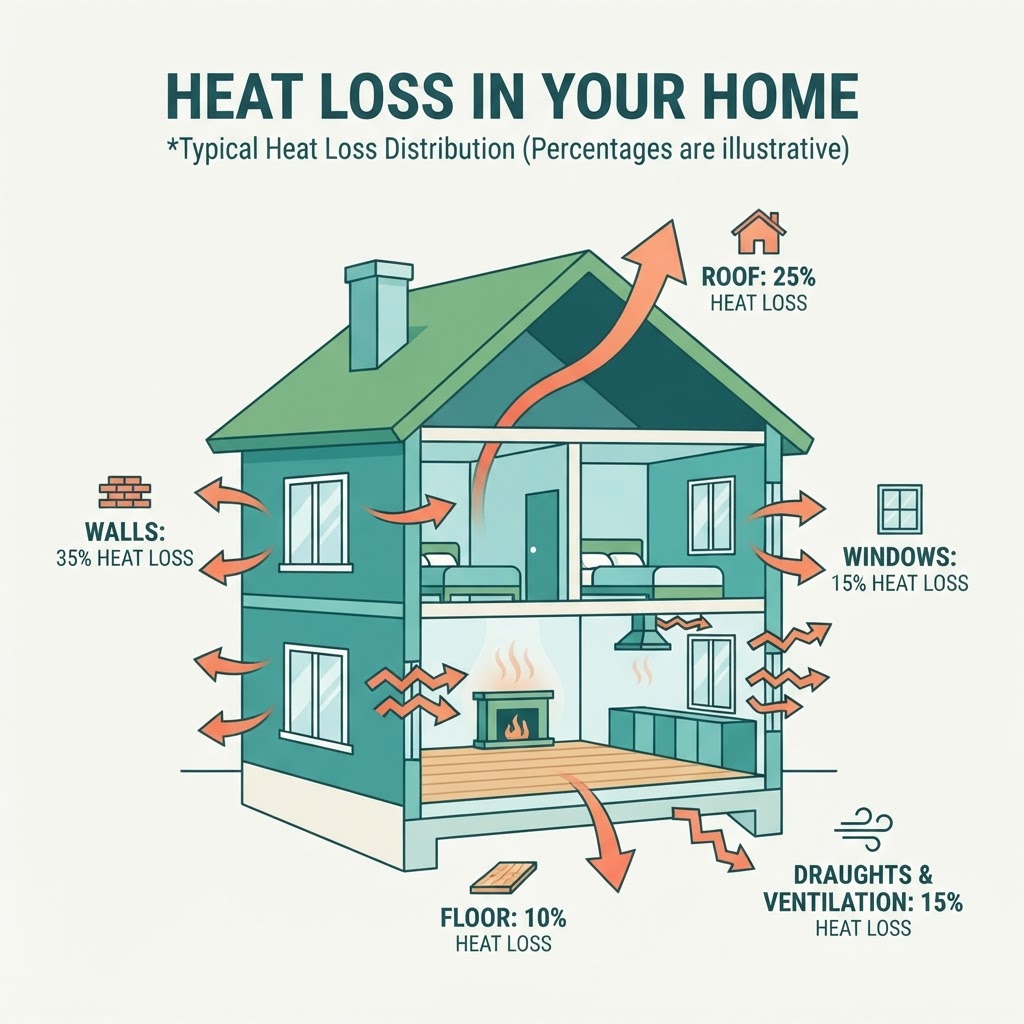
Insulation first is not just a paperwork hurdle. A better-insulated home has a lower heat loss, which means a smaller heat pump, a cheaper installation and lower running costs for the life of the system.
How the money flows
- You choose an MCS-certified installer and accept a quote.
- The installer applies to Ofgem for a voucher against your property, with your consent. You will be contacted to confirm you agreed to the work — this is a fraud check, and it is normal.
- The installation is carried out and MCS-certified.
- The installer redeems the voucher and the grant is deducted from your invoice.
You pay only the difference. There is no reclaim process, no waiting for a refund, and no need to fund the grant amount up front.
Timescales
Vouchers have a validity period, so the work needs to happen within a defined window after issue. In practice, a straightforward domestic installation runs roughly like this:
- Week 1: technical survey and heat loss calculation
- Week 2: design and quotation
- Weeks 3–4: voucher application, consent confirmation and scheduling
- Weeks 5–8: installation, typically 2–5 days on site, then commissioning and certification
Radiator upgrades, cylinder relocation or electrical supply work can extend that.
What the grant does not cover
The grant is a fixed contribution to the heat pump installation. It does not fund insulation works, new radiators bought separately, general plumbing improvements unrelated to the system, or ongoing running costs. Some households may also be eligible for separate insulation support through other schemes depending on income, benefits or property type.
Can you combine it with solar?
Yes. Solar PV is funded separately (it is not part of BUS), but the two work well together: a heat pump increases your electricity demand, and solar reduces the amount of that electricity you buy. Many households install both at the same time to share scaffolding, electrical work and disruption.
Important caveats
Grant levels, eligibility criteria and scheme end dates are set by government policy and do change. Nothing on this page is a guarantee of eligibility or of any particular amount. Always check the current official guidance from Ofgem or GOV.UK, or ask us to confirm what applies to your property at the time you enquire.
How we handle it
We check EPC status and eligibility before quoting, apply for the voucher on your behalf, and show the grant as a clear deduction on your quotation so you can see exactly what you are paying. Our grant checker tool gives you an indicative answer in a couple of minutes.