Commercial Solar Feasibility: What We Assess Before You Invest
The feasibility questions that decide whether rooftop solar stacks up for a UK business: roof and structure, half-hourly consumption data, grid connection, and the financial modelling that follows.
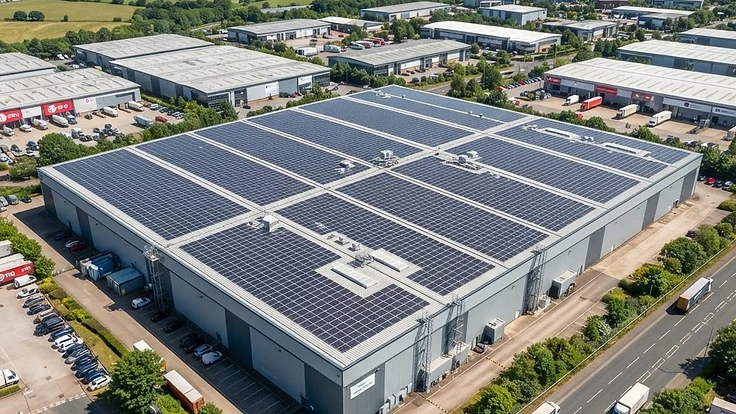
In short: commercial solar succeeds or fails on three questions. Can the roof physically and structurally take an array? Does your consumption profile line up with when the sun shines? And will the grid connection allow the export you need? A proper feasibility study answers all three with evidence before anyone quotes a price.
Why commercial solar is a different discipline
Domestic solar is sized to a roof. Commercial solar is sized to a load profile. A business that consumes electricity through the working day — refrigeration, machinery, IT, air conditioning — can use its own generation as it is produced, which is where the value is: every self-consumed kilowatt-hour displaces electricity bought at full commercial rates, while exported surplus earns far less.
1. The roof and structure
- Structural capacity. Many commercial roofs — especially older steel portal frames with lightweight cladding — were not designed for extra load. A structural engineer’s assessment of the frame and purlins is non-negotiable, and it determines whether the array is ballasted, clamped or reduced in size.
- Roof covering age and condition. Panels last 25+ years; a roof covering with 8 years left means stripping the array mid-life. If recladding is due, doing it with (or before) the solar is far cheaper than doing it after.
- Fixing method. Trapezoidal sheet, standing seam, built-up flat membrane and composite panels each need different mounting systems, with different warranty implications for the roof.
- Access, fragility and safety. Fragile rooflights, asbestos cement sheets and edge protection all shape the installation plan and cost.
2. Your consumption data
For half-hourly metered businesses, we work from your actual HH data — a year of 30-minute consumption readings from your supplier. This shows precisely how much of a proposed array’s output you would self-consume versus export, month by month, hour by hour. It is the difference between a financial model and a guess.
Patterns that model well: daytime manufacturing, cold storage, offices with heavy daytime HVAC, retail with long opening hours. Patterns that need more care: evening-weighted hospitality, weekend-quiet sites, highly seasonal loads.
3. The grid connection
Commercial arrays usually require an application to the District Network Operator (DNO) before installation. The DNO may accept the proposed export, offer a lower limit, require an export limitation device, or quote for network reinforcement. Connection capacity is a genuine constraint in parts of the network, and it can cap the sensible system size regardless of roof area. We handle the application and design within the answer, not against it.
4. The financial model
With the physical and network constraints established, the model brings together:
- Capital cost, including any structural or roofing works
- Self-consumption value at your actual supply rates
- Export income on realistic terms
- Operations and maintenance, inverter replacement mid-life, insurance
- Capital allowances and financing structure — outright purchase, finance lease or a power purchase agreement (PPA) where a third party funds the array and sells you the electricity
Typical well-matched commercial systems in the UK currently model payback in roughly the 4–8 year range, but that spread is wide precisely because load matching varies so much. We present the assumptions openly so your accountant can interrogate them.
What else gets checked
- Planning. Most commercial rooftop solar is permitted development, with exceptions for listed buildings, conservation areas and some height and edge conditions.
- Insurance and fire. Insurers increasingly ask about DC isolation, cable routing and panel certification. We design to satisfy them and document it.
- Landlord consent. Leased premises need the freeholder on board early; PPAs can align landlord and tenant interests.
- Monitoring. Commercial systems justify proper generation monitoring with alerts — an underperforming string on a big roof is real money.
What you receive from us
Our feasibility study delivers a structural summary, a shading-modelled array layout, a self-consumption analysis from your HH data, the DNO position, and a financial model with payback, IRR and sensitivity to energy prices — the evidence to take to your board or your bank. If the site does not stack up, the study says so plainly, and it will have cost you far less than finding out after installation.